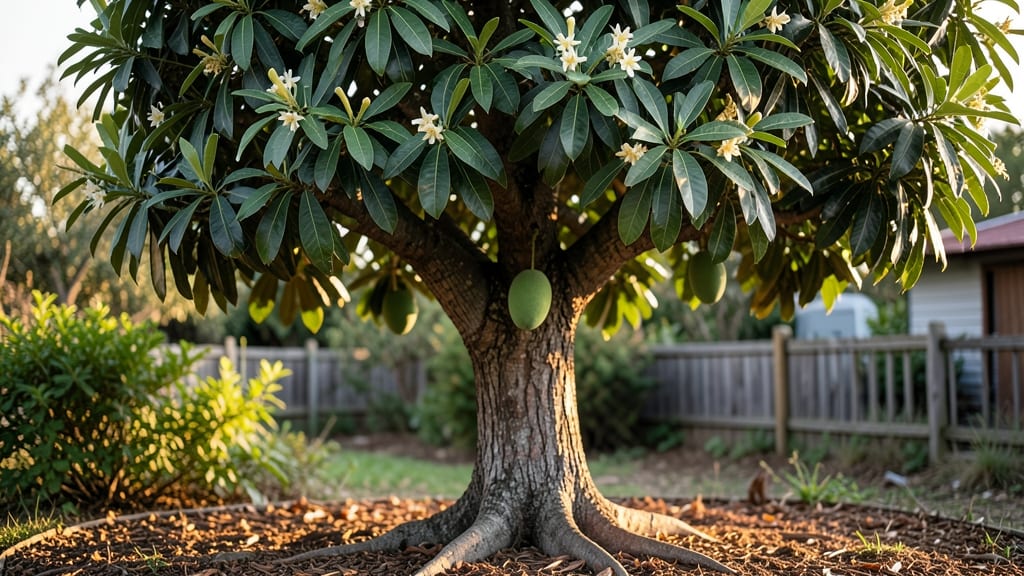
How tall can mango trees grow? They can reach heights between 30 and 100 feet, depending on the variety and growing conditions 🥭 — a range that turns your backyard into a jungle or a manageable patio feature with the right choices.
Ever wondered why your backyard mango tree seems to stretch endlessly toward the sky—or if it’s actually normal? The height of a mango tree isn’t just about space; it’s about variety, climate, and care.
Some varieties stay compact, perfect for containers or small gardens, while others reach towering heights that require careful planning. If you’re dreaming of fresh fruit but worried about size, we’ll show you how to pick the right tree and control its growth for your space.
From dwarf varieties that fit patios to giants that need acres, here’s what you need to know to grow a mango tree that works for you—no matter how much room you have.
Mango tree height by variety: from dwarf to giant sizes
If you’ve ever dreamed of growing mangoes in your backyard, you’ve likely wondered: how tall can mango trees grow? The answer varies dramatically by variety, with some reaching skyscraper heights of 80+ feet, while others stay compact enough for container gardening.
The key lies in selecting the right cultivar for your space and climate. For example, the 'Cogshall' variety tops out at 20–30 feet, perfect for suburban yards, while the 'Keitt' can soar to 60–80 feet, requiring acres of space.
Let’s explore the spectrum of mango tree heights and how to choose the best fit for your garden.
Mango trees are tropical powerhouses, and their height isn’t just about genetics—it’s also shaped by growing conditions, pruning practices, and even your local climate zone.
In ideal tropical settings, a standard mango tree can grow 3–4 feet per year during its first decade, while dwarf varieties grow just 1–2 feet annually. Understanding these growth rates helps you plan for long-term space needs.
For instance, a 10-year-old 'Haden' mango tree might stand at 35–45 feet, while a 'Ice Cream' dwarf variety would only reach 12–15 feet in the same time.
Before we dive into the varieties, here’s a quick rule of thumb: dwarf mango trees are bred for small spaces, semi-dwarf varieties offer a middle-ground height, and standard types are for large landscapes or farms.
Your choice depends on whether you prioritize fruit production, ease of harvesting, or simply fitting the tree into your yard. Below, we’ve organized the most popular mango varieties by height category, complete with growth timelines and climate preferences to help you decide.
Mango Variety Height Comparison
🌱 Growers Guide
| Variety |
Height at 5 Yrs |
Height at 10 Yrs |
Mature Height |
Growth Rate |
Climate Zone |
| Dwarf Varieties |
6–10 ft |
10–15 ft |
12–25 ft |
1–2 ft/yr |
Tropical/Subtropical |
| 'Ice Cream' |
8 ft |
12 ft |
15–20 ft |
1.5 ft/yr |
Zones 10–11 |
| 'Julie' |
7 ft |
10 ft |
12–15 ft |
1 ft/yr |
Zones 10–11 |
| 'Carrie' |
9 ft |
14 ft |
18–22 ft |
1.8 ft/yr |
Zones 10–11 |
| Semi-Dwarf Varieties |
12–18 ft |
20–30 ft |
30–45 ft |
2–3 ft/yr |
How growing conditions affect mango tree height (and how to control it)
Your mango tree’s height isn’t just genetics—it’s a mix of climate conditions, soil quality, and how you prune it. In tropical zones like USDA 10-12, mangoes can reach 80+ feet without intervention, while cooler subtropical areas (USDA 9-10) cap them at 30-50 feet.
Even the same variety grows taller in well-draining sandy soil than in heavy clay. Let’s break down how to manage this growth for your space.
Sunlight is the biggest height accelerator. Mango trees need full sun (6+ hours daily) to fuel rapid vertical growth. In partial shade, they’ll grow 30-50% shorter but produce smaller fruit. If you’re in a container, limit sun to 4-6 hours to naturally restrict height—though yields will drop.
My Ice Cream mango in a 20-gallon pot stays under 15 feet because I move it to shade after 4 PM.
Soil pH and nutrients also play a role. Acidic soil (pH 5.5-6.5) with balanced NPK (10-10-10) encourages strong upward growth, while nutrient-poor soil stunts height but can improve fruit quality.
Over-fertilizing with nitrogen? You’ll get leafy growth but shorter trunks. Always test your soil before planting—mango roots need aeration to support towering growth.
⚠️ Common Pruning Mistakes That Stunt Mango Growth
Topping (cutting the main trunk flat) causes sprout explosions but weakens the tree’s structural integrity. Over-pruning in winter removes next year’s fruit buds. Uneven cuts invite disease. Always prune just above a bud at a 45-degree angle and avoid removing more than 25% of foliage in one session.
Pro Tip: Use sterilized pruners and seal cuts with pruning sealant to prevent fungal infections that slow growth.
Pruning for fruit production vs. size control requires different timing. To encourage height, prune lightly in late winter (just before buds swell). For compact growth, prune heavily in early summer after flowering.
My Keitt mango needed aggressive summer pruning—cutting 1/3 of new growth kept it under 25 feet while still yielding 50+ fruits per season.
Climate zones dictate natural height limits. In tropical zones (USDA 10-12), mangoes grow uncontrolled without pruning, while subtropical zones (USDA 9-10) see slower growth due to cooler winters.
If you’re in USDA 8, choose dwarf varieties like Julie—they max out at 12-15 feet and handle brief cold snaps better than standard types. Always check your zone before planting!
For container-grown mangoes, root pruning is key. Every 2-3 years, trim 10-15% of roots to match the pot size. This forces the tree to stay proportional to its container.
Pair this with regular defoliation (removing 20% of leaves in summer) to slow vertical growth. My Carrie mango in a 30-gallon pot stays under 18 feet using this method—perfect for patios!
★★★★★4.9(10 reviews)
|