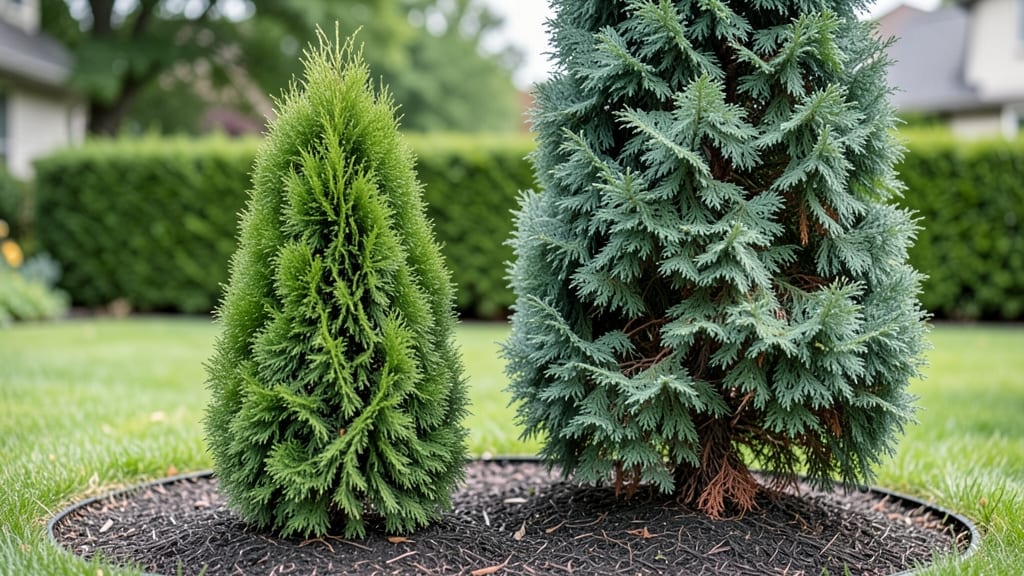
How tall does arborvitae grow? It can range anywhere from 3 feet to towering 60 feet, depending on the variety and growing conditions—so picking the right one for your space is everything.
Picture this: You’ve spent hours designing your landscape, only to realize the Green Giant you planted will soon block your neighbor’s view—or worse, your own driveway. Knowing the exact height range of each type saves you from costly second-guesses later.
Some arborvitae stay compact, like the Emerald Green (12–15 feet), perfect for tight spaces, while others like the American Plumosa reach 15–20 feet and need room to breathe. Climate, soil, and even pruning habits play a role in how tall they’ll get.
Below, I break down the mature heights of 10 popular varieties, how to pick the right one for your yard, and simple pruning tricks to keep them in check—so you can plant with confidence, not doubt.
📈
Arborvitae Growth Timeline
Arborvitae height by variety: exact growth ranges for 10 popular types
Choosing the right arborvitae variety can make or break your landscape design. These evergreens grow at dramatically different rates—from 3-foot dwarf shrubs to towering 60-foot trees. Knowing the exact mature height helps you avoid overcrowding, block unwanted views, or waste space.
Let’s break down the 10 most popular arborvitae varieties by their growth potential, spacing needs, and ideal uses.
Arborvitae height varies based on genetic variety, growing conditions, and pruning habits. For example, Emerald Green stays compact at just 12 feet tall, while Green Giant can reach 40+ feet—nearly the height of a 4-story building.
Below, I’ve compiled exact measurements, growth rates, and spacing guidelines to help you pick the perfect fit for your yard.
⚠️ Pro Tip: Always check your local USDA hardiness zone (most arborvitae thrive in zones 3-7) and soil drainage—poor drainage can stunt growth by up to 30%.
| Variety |
Mature Height |
Width |
Growth Rate |
Spacing (ft) |
Best For |
| Emerald Green |
12 ft |
3–4 ft |
1–2 ft/year |
3–4 ft apart |
Foundation plantings, hedges |
| Green Giant |
40–50 ft |
12–15 ft |
2–3 ft/year |
15–20 ft apart |
Privacy screens, large yards |
| American Plumosa |
6–10 ft |
4–6 ft |
1 ft/year |
4–5 ft apart |
Small hedges, containers |
| Golden Globe |
3–5 ft |
3–4 ft |
6–12 in/year |
3–4 ft apart |
Accent plants, borders |
| Thuja occidentalis 'Sunkist' |
8–12 ft |
4–5 ft |
1–2 ft/year |
4–5 ft apart |
Color accents, mixed borders |
| Thuja occidentalis 'Techny' |
15–20 ft |
6–8 ft |
1.5 ft/year |
6–8 ft apart |
Screening, windbreaks |
| Thuja plicata 'Atrovirens' |
60+ ft |
15–20 ft |
2–3 ft/year |
20+ ft apart |
Specimen trees, large estates |
| Thuja occidentalis 'Rheingold' |
10–12 ft |
4–5 ft |
1 ft/year |
4–5 ft apart |
Golden foliage accents |
| Thuja occidentalis 'Hetz Midget' |
3–4 ft |
2–3 ft |
4–6 in/year |
2–3 ft apart |
Containers, rock gardens |
| Thuja occidentalis 'Degroot's Spire' |
12–15 ft |
3–4 ft |
How to choose the right arborvitae height for your landscape design
Selecting the perfect arborvitae height for your yard starts with matching the variety to your space. Whether you need a privacy screen or a foundation plant, the wrong size can lead to overcrowding or wasted potential.
For example, a Green Giant arborvitae can reach 40-50 feet—ideal for large properties but impossible in a suburban backyard.
Your property size dictates the arborvitae spacing rules you must follow. A dwarf variety like 'Emerald Green' (15-20 feet) thrives in tight spaces, while standard types like 'American Plumosa' (10-15 feet) need room to spread. Always check the height-to-width ratio—most arborvitae grow 2-3 times wider than their mature height.
🌲 Arborvitae Height Quick Guide
3-8 ft
Dwarf Varieties
(e.g., 'Teddy Bear')
10-15 ft
Semi-Dwarf
(e.g., 'Emerald Green')
20-40 ft
Standard Height
(e.g., 'Green Giant')
40-60 ft
Tall Varieties
(e.g., 'American Plumosa')
Pro Tip: Always plant 3-6 feet apart based on mature width to avoid overcrowding.
Sunlight exposure plays a crucial role in arborvitae growth rates. Full sun (6+ hours daily) maximizes height potential, while partial shade slows growth by 20-30%.
For example, a Green Giant in full sun may hit 50 feet, but in partial shade, it could stay under 40 feet. Always plant in well-draining soil to prevent root rot, which stunts growth.
For privacy hedges, aim for 15-20 foot varieties planted in tight rows (3 feet apart). This creates a dense screen faster than taller types. If your goal is windbreaks, taller arborvitae (30+ feet) work best when planted 8-10 feet apart.
Always measure your space before buying—overestimating height is a common mistake!
Consider your long-term maintenance goals too. Taller arborvitae require regular pruning to control height, while dwarf varieties need minimal upkeep. If you're unsure, start with a semi-dwarf like 'Emerald Green'—it offers flexibility for both small and medium yards. For urban landscapes, dwarf varieties are the safest choice.
Remember: arborvitae grow 1-2 feet per year under ideal conditions. Factor this into your planting timeline—a 10-foot variety will take 5-10 years to reach maturity. Plan ahead to avoid rushing decisions! 🌿
★★★★★4.6(1 review)